Where is Mount Kailash? Country, Height & Facts
Mount Kailash lies in Tibet (China) and rises to 6,638 m. Which country it is in, why four religions revere it, Manasarovar and the parikrama.
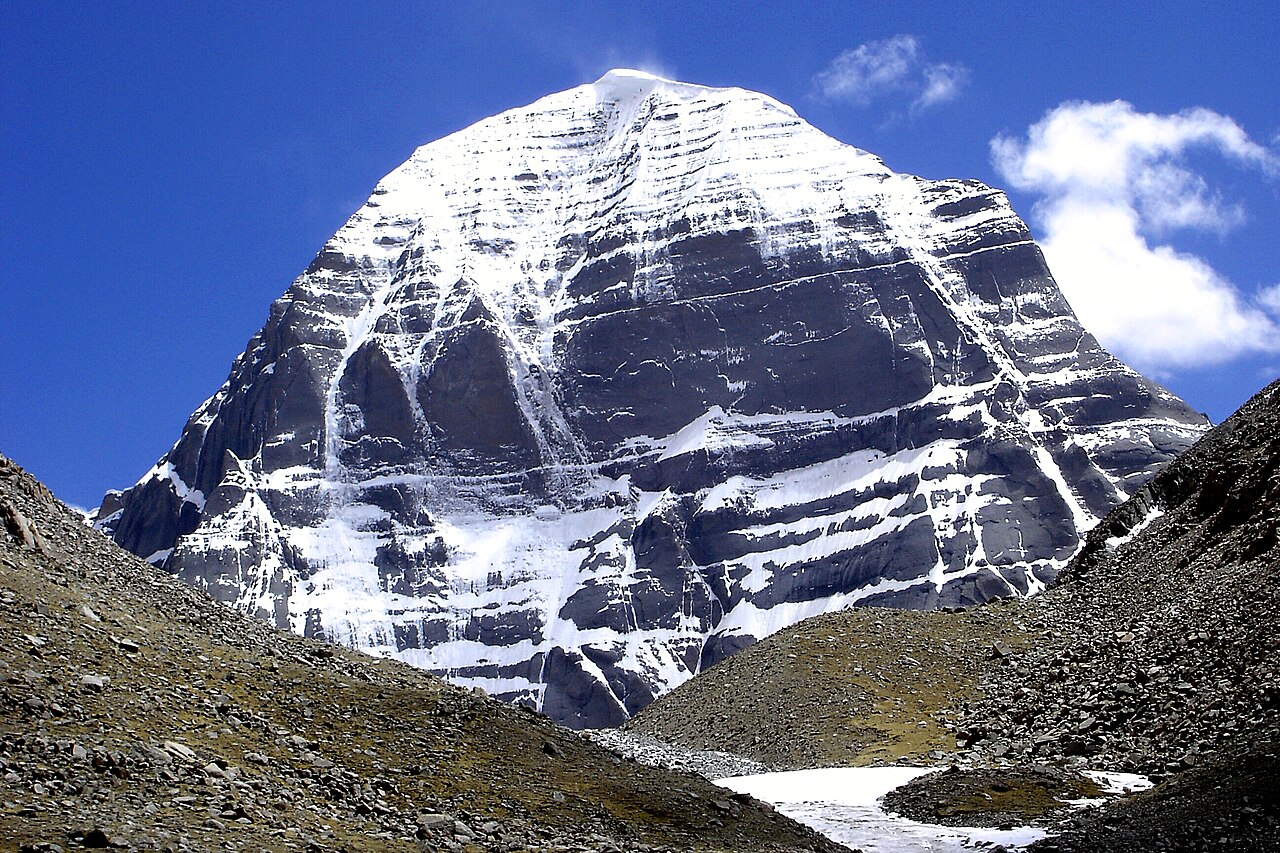
Beyond the Himalayas, high on the Tibetan plateau, stands a white peak that hundreds of millions revere as the very abode of Lord Shiva — Mount Kailash. Here faith, mystery and nature seem to stand still together. Let us understand why this mountain is so deeply worshipped.
Where is Mount Kailash?
Mount Kailash lies in the Ngari Prefecture of Tibet (China), in the Gangdise (Kailash) range of the Trans-Himalaya. It rises to about 6,638 metres (21,778 ft). Its shape is like a giant pyramid or a diamond, and its four faces point roughly toward the four cardinal directions.
Sacred to four living religions
Kailash is perhaps the only mountain on earth held supremely sacred by four living religions at once:
- Hinduism: the home of Lord Shiva and Goddess Parvati; also seen as the centre of the universe (Mount Meru).
- Buddhism: regarded as the abode of Demchok (Chakrasamvara).
- Jainism: believed to be where the first Tirthankara, Rishabhadeva, attained liberation (Ashtapada).
- Bon: in Tibet's ancient Bon tradition, it is the supreme sacred peak.
Source of four great rivers
The Kailash region can be called the "water tower of Asia." Within roughly 60 km, four major rivers take their source — the Indus, Sutlej, Brahmaputra (Yarlung Tsangpo) and the Karnali (Ghaghara, a tributary of the Ganges).
Manasarovar and Rakshastal
Two lakes lie near Kailash — the sacred Lake Manasarovar, seen as a symbol of purity of mind, and nearby Rakshastal. Bathing in and circling Manasarovar is an important part of the pilgrimage.
Kailash Mansarovar Yatra and the parikrama
Every year thousands of devotees undertake the Kailash Mansarovar Yatra. The parikrama (kora) around the mountain is about 52 kilometres, crossing the high Dolma La pass (around 5,600 m). It is believed that a single circumambulation washes away the sins of a lifetime.
Before you go
The Kailash yatra involves extreme altitude and harsh weather — proper preparation, permits and a health check are essential. Always consult a trusted operator and a doctor before the journey.
The mysteries around Kailash
- No one has ever reached the summit: despite many mountaineers, there is no verified record of a climb to Kailash's peak. In 2001 China banned all climbing here. Even legends like Reinhold Messner and Sir Edmund Hillary declined to climb it, out of respect for its sacredness.
- Four faces toward the directions: its four sides align roughly north–south–east–west.
- The Om / swastika form: on the south face, a vertical cleft and horizontal strata together form a swastika-like shape that devotees consider auspicious.
A note on facts
Many claims about Kailash (such as time passing faster, or compasses behaving strangely) are folk beliefs and travellers' anecdotes, not scientifically proven facts. Faith has its place — but it helps to know the difference between belief and evidence.
A shloka to Lord Shiva
कर्पूरगौरं करुणावतारं संसारसारं भुजगेन्द्रहारम्।
सदा वसन्तं हृदयारविन्दे भवं भवानीसहितं नमामि॥
karpūra-gauraṁ karuṇāvatāraṁ saṁsāra-sāraṁ bhujagendra-hāram, sadā vasantaṁ hṛdayāravinde bhavaṁ bhavānī-sahitaṁ namāmi
Meaning: White as camphor, the very embodiment of compassion, the essence of existence, wearing the king of serpents as a garland — I bow to Shiva, who dwells forever in the lotus of my heart, together with Goddess Bhavani.
ॐ नमः शिवाय
PanchakshariKailash is not merely a mountain — it is a symbol of faith, discipline and self-discovery. Every step toward it turns the mind toward Shiva. Har Har Mahadev.
Photo: North face of Mount Kailash — photographer Ondřej Žváček, Wikimedia Commons (CC BY 2.5).
You may also like
18 Shakti Peethas: Names, Places & Full List
The 18 Maha Shakti Peethas named in Adi Shankaracharya's stotram — goddess, temple, place and state for each, and why other lists count 51, 52 or 108.
Char Dham List: 4 Dhams, Chota Char Dham & 2026 Dates
The Char Dham explained — the original four dhams of Badrinath, Dwarka, Puri and Rameswaram, and Uttarakhand's Chota Char Dham, with places, order and 2026 dates.
12 Jyotirlingas: Names, Places & Full List
The 12 Jyotirlingas of Lord Shiva — the complete list with locations and states, from Somnath to Grishneshwar, and what makes each one special.